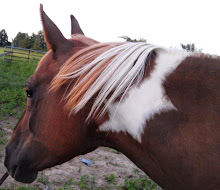
I know I don't have a lot of readers, especially after months of absenteeism, but perhaps the few I have can spread the word on a herd of Arabs needing new homes in Indiana. This is the information I received from a trail riding group. Please pass this on and help these ponies out!
Indiana - Arabs in need of new homes ASAP
Tex is a 3 year old rose grey stallion, halter broke and gentle but he needs his feet trimmed BAD at this point.
Rebel is a 5 year old bay stallion, halter broke but skittish.
Lady is a 10 year old bay mare with a 23 day old baby stud colt. She is halter broke, friendly but the baby has not been handled.
Sammy is an 8 year old dapple grey gelding, halter broke and friendly but low on the pecking order so shy and bitten up bad.
Baby is an 11 year old bay mare that has had two fillies and is re-bred. Halter broke and friendly.
NikkiDo is a 7 year old bay mare that is bred for next Spring/Summer and is halter broke and friendly.
Autumn is a 6 year old bay mare that I am sure is bred too, halter broke and friendly but a little shy at first.
Shadow is a 6 year old bay gelding that has been ridden a little, halter broke and really friendly.
All these horses are purebred Arabians. They need new homes ASAP. They are standing in belly deep grass but all are thin with pot bellies so they need wormed and I assume most need their teeth floated. The lady that has these horses is from Texas and ended up here and is in over her head. She has belly deep grass but no fence to speak of and she has two young stallions that keep getting out. I need to help her place IN GOOD HOMES ONLY as she has raised most of them and she is an older lady so she thinks of them as her children. She has not had the money for shots either. This lady's heart is in the right place but she is in way over her head. She thinks of all of them as "her babies" so she wants good homes for them. With a little TLC, some handling and some vet and farrier work they would all make extremely nice riding horses. The mares have been allowed to run with the stallions until I separated them so all the mares are probably bred to the rose grey, Tex, because he is the dominant stud. The poor dapple grey took it tough from both the mares and the studs so he is pretty bitten up but still comes to you as soon as you go in the pen. I have no way to separate him or Shadow out from the mares so all he does is run from one end of the pen to the other to avoid the mares. Shadow has no problem with them.
The lady found a bunch of paperwork for me and I contacted the Arabian Horse Club and found out that they will run DNA tests (you pay for them of course) and the Arabians can be registered. The grey gelding is already registered as "Sam I Am" and has been DNA tested already. He has also been ridden and would not take much to refresh him. The other gelding "Shadow" can also be registered thru DNA and he has been saddled and worked with but not ridden. I picked up one of the mares last night and brought her to my house. She loaded with no problem what so ever and rode like a champ in the trailer. A little shy when she got off the trailer but settled right down and was led to her pen. I really believe that it would not take much at all to have all these horses going with a little work and TLC. Please contact:
Nikki Dorsey
pappydoodle@hotmail.com for more details.
To see pictures of them go here: http://www.facebook.com/media/set/?set=a.1745903408035.2088390.1252279426&l=ef017dc282#
Showing posts with label rescue. Show all posts
Showing posts with label rescue. Show all posts
Sunday, May 29, 2011


Tuesday, February 16, 2010
So Long, Jack Tripper
This story was written by a friend, Terri of Good Hands Horse Training & Sales (see her blog here). I like to bring awareness to some of the unpleasant circumstances in which good horses may find themselves (see the story of Clever Allemont, a Graded stakes winning Thoroughbred). Jack could've been someone's "forever" horse, but he fell into the wrong hands. As a result, Jack suffered severe psychological trauma that he could never truly overcome. He was humanely euthanized last week.
A couple days ago I put to rest a fine young horse. No catastrophic wound, no terminal illness. No external reason to let him go. This horse was Jack, the rescue horse. Some of you have followed his story, since that icy February day, two years ago that he arrived in Sioux City, via Nebraska Humane Society stock trailer, some from even earlier when he and several other horses were seized by the Nebraska Humane Society from a North Omaha barn the previous spring.
Jack had been used as a trip horse in a backyard Mexican rodeo. For you not familiar with the sport, it is something akin to our American calf roping event, only it’s a horse that’s hazed down an alley and then is caught around the front legs and brought to the ground, at speed. He survived that experience with minimal physical injuries but was left with a deep and abiding panic disorder and it was that which would be the end of him. The authorities were only able to seize the horses after they were discovered emaciated and on the edge of death by starvation, as there were no ordinances in place at that time in the city of Omaha, banning the sport.
 I had warned the NHS officers if they brought me a nutcase, we’d soon be euthanizing or I’d have to be free to dispose of him as I see fit. I grew up in rural Northern California ranch country and while I love my horses, I do view them as livestock. With that view, I believe responsible horse owners should be able to dispose of their livestock in the manner they see fit, and I made that very clear. The horse that came off the trailer was not remotely what I was expecting. Scared, yes, but humble and hopeful, he took a good look around before carefully and sanely depositing himself on the ground. I had a good grip on the halter rope, the thought he might want to leave the country, me skiing along behind was large on my mind.


There were many signs along the way that this could be a very successful journey. What happened to him destroyed his confidence, but it did not destroy Jack’s play drive. A horse that will engage and play can surely be saved, I thought. We established a “rope game” that we would play when Jack was stressed and it would help him gain his composure. I found that game by accident. Not surprisingly, after he’d beat his face against the side of a barn, Jack was none too keen on wearing a halter and it took some doing to get one on him. I won’t ever force a horse but attempt to build their willing cooperation, and there was not much coming from him on this score. Into the round pen we went, him on a neck rope made from my 22’ line. I looped it over his neck, crossed it under and stood back at a safe distance, should he strike at the offenders, which could includeme. I would gently flop them a little, letting him feel the lines softly on the sides of his face. The aim was to desensitize him to touch on his face and let him know that could happen without pain or fear. Much to my surprise, Jack reached for the lines and would bump them with his nose. I’d flop them at him; he’d bump them back at me. He’d even mouth them, shaking his head, creating a similar ripple effect at me that I was sending at him. From then on, when Jack had trouble, he’d ask for the rope game and we’d take a moment and play til he could move on to the next step.
 The horse put me in tears every time I worked with him in those early days. I am no maudlin ill informed animal rights sympathizer. As I said, I love my horses and they are also livestock, intended to do a job, as well. This horse had as much heart and try as any I have ever laid my hand or eye on. There would be times what I would ask him to endure would be very hard for him. He’d been whipped, as he’d soon learned if he run, he’d be thrown and he’d apparently tried to refuse to run until his back was opened up, and he had no choice. I asked Jack to allow my to put my stick and string gently all over his body, including around his legs, neck and back. I started far back, just moving the stick and string on the ground, many feet away from him. He would tremble and snort, and sometimes would retreat inside himself in an almost catatonic manner. I know, once a thing is begun, you have to see it through to not leave a horse in doubt which only creates deeper fears. I would reduce the stimulation while continuing to engage him, and he would come back to himself, blinking, licking and chewing. One day, the yawning began. People often mistakenly believe horses yawn when they are bored, it is actually connected with an adrenalin release. Jack would yawn until his eyes rolled up in his head and tears from his damaged ducts would roll down his face. They were matched by my own. He would focus on me with both ears and both eyes, would take steps toward me, and reach for me with his nose. I reached right back with all the heart I have for a horse.
 That first couple of months, I had him not only accepting the touch of that string, but wearing a saddle blanket, a hula hoop, and had very high hopes that the following year we would debut at the Nebraska Horse Expo. I had even picked out the music (Boondocks, by Little Big Town) and was writing the story in my head of the redeemable throwaway horses. Jack would walk over tarps; he learned to tolerate squeezes, which would be terrifying to a naturally claustrophobic animal that had learned just how bad such a trap could be. I thought this would be as fine of an example of why not to give up on a horse as there ever could possibly be.

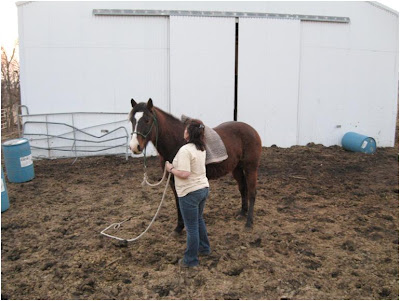 Never, though, with all these gains, did he get fully calm or gentle. The least noise would send him into a startle, the white would return to his eyes, the tension to his body. Fight or flight was his first line of response and that, I could not change.
I taught him to be caught, worked with him in the round pen, teaching him to disengage his hip at liberty, face up and come to me. I have snotty saddle horses that would make the choice to not, but Jack, anywhere, any time . . . if I could catch his eye, and release the pressure to him as he’d look at me, he’d face up and often as not, come to me on a line straight as a die even with me walking away from him, he’d fall in at my shoulder.
 I firmly believe it was this horse’s deep level of trainability that was his undoing. He’d learned that life is unpredictable which is something I teach all my colts, but unlike them, he’d learned it was unpredictable in bad and awful ways and that was entrenched to an instinctive level I guess I had no hope of reaching. I kept trying though, and so did he.
I’d heard he’d jumped a fence at the sight of a mounted rider in his first foster home, and watched with interest the first time I mounted a horse in the round pen with Jack munching hay on a round bale with the brood mares not 30 feet away. As I stepped into the stirrup, his head flies up in alarm. He glances at the mares as if to say “hey, don’t we have to get out of here, and NOW?” Those lazy girls paid neither he nor I the slightest heed and his curious attention went back and forth, from the calm, confident horse I was riding in the pen to the unconcerned ladies he lived with . . . I could soon ride almost close enough to touch him from the saddle. Never quite managed that, though.
There were long blocks of time Jack just got to be a horse. Professional trainer, my projects are back burnered when I have paying horses in the barn, and it works better when I have them there more often than not. Jack babysat my last foal crop and if there were any reason for me to be raising babies, he’d have had a job for life. Kind and sensible with the youngsters, he was a good and steady influence when weaning time came.
 Then came the fateful day I decided he was ready to try a saddle. We’d done a lot of good work, seemed to me he was coming right along. A few stutters here and there, but it seemed moving forward was the good and likely direction. What I will say here, is that if I had that day to do over, I’d have done it a little different. Every other step I took with that horse, I broke it down to steps that made paint drying look fast. That day, I just saddled him up. I had already, of course, desensitized him to feeling pressure on his girth and back cinch area, had led him around off the girth rope. What I did not take into account was my habit of releasing to give, and when Jack would come with me, I’d release pressure to let him know he was doing the right thing. Saddles don’t release pressure, and when Jack moved away, and the pressure came with him, I think it blew his mind. I have never, in all my life, and I have seen some bucking, exploding horses, seen a horse react like this. End shot, he took out a couple panels of my round pen, bucked and ran around a three acre pasture (don’t let anyone ever tell you a horse cannot buck and run at top speed, if there was more speed than that, he should have been on the track and wow, what an athlete . . .). I finally got him directed into a pen, and he bucked and charged back and forth in that pen until he hooked the stirrup on a fence post and tore the saddle off. What broke my heart is I don’t think he even knew the saddle was gone. Nothing in his behavior changed, he bucked, kicked and lashed out hysterically, sweat and lather rolling off his body. As he became exhausted, he put himself into small circles, occasionally throwing a buck, or lashing out with a kick, hanging his head, gasping for air, and then off he’d go again.
Sick at heart, I waited until there was life in his eyes and called his name. He wanted none of me, and I let him sit, dragging his halter rope, while I went about my business, checking on him occasionally. By evening, I felt safe to go in and get him caught. We were back to zero. I pulled his halter and walked away. At any point during that terrible wreck, I waited for him to hurt himself, leap through a fence, tear himself open or break his leg. It is thought the grace of God as I understand him that Jack came through with only some minor cuts and scrapes.
How fair was this? How much of my ego was getting tied up in bringing back the dead? How could I ever know, no matter how far I got with him, that something would not set off that blind panic and he’d kill himself, or me or cause death or injury to an innocent bystander?
I worked with Jack a couple more times after this, still thinking . . . maybe. I could do so many things with him! That horse would do flawless groundwork, floating around on a draped line . . . no more pressure than it takes to move the theoretical toy boat in the bath tub. And he would panic.


 It was time to stop. This was a great kind horse who should have been someone’s forever not for sale at any price love of their equine life. It was not in the cards for him. I vowed to give him a home in safe pastures as long as I had hay to give. Little did I know that my circumstances would soon change and that would become not possible.
I am one to seek wise council from informed friends and then tend to do what I think best, anyway, but in this case, we were all agreed. It was time to let him go rather than see that fine and damaged horse ever find himself in harms’ way, no matter how well intended, ever again. I opted to not put him on a truck. While I don’t mind that end, done safely and humanely, this horse had suffered enough at the hands of human beings, and deserved his death to be kind, dignified and as quietly loving as I could manage.
Rest in peace, Jack Tripper, and may I never forget the gifts and lessons in spirit, heart and courage that I got from one throwaway bay horse.

A couple days ago I put to rest a fine young horse. No catastrophic wound, no terminal illness. No external reason to let him go. This horse was Jack, the rescue horse. Some of you have followed his story, since that icy February day, two years ago that he arrived in Sioux City, via Nebraska Humane Society stock trailer, some from even earlier when he and several other horses were seized by the Nebraska Humane Society from a North Omaha barn the previous spring.
Jack had been used as a trip horse in a backyard Mexican rodeo. For you not familiar with the sport, it is something akin to our American calf roping event, only it’s a horse that’s hazed down an alley and then is caught around the front legs and brought to the ground, at speed. He survived that experience with minimal physical injuries but was left with a deep and abiding panic disorder and it was that which would be the end of him. The authorities were only able to seize the horses after they were discovered emaciated and on the edge of death by starvation, as there were no ordinances in place at that time in the city of Omaha, banning the sport.


Then, as almost always, Jack was light and respectful on the leadline. I have worked with a lot of horses in my life and you don’t get that kind of response without someone putting in some intelligent effort and hours into a young horse. The fellows running their rodeo had purchased their stock from a killer buyer, but I’ll lay good money whoever brought this colt to auction had no idea of his more than likely end. He was intact, maybe had his papers, maybe did or did not ride . . . There’s too many of those in the world right now for the people we have available that are able and willing to bring them along and horses with more opportunity than Jack have gone down the long road on a truck.

Jack blew up the second day I had him. I had been told he could stand tied, and rather than check that out for myself, I tied him. That’s when I first got to witness his panic in full color as he blindly fought and struggled to free himself. Once he’d tangled himself enough to choke himself down, I was able to cut the rope and get him free. From that point on, I took nothing for granted with this horse, and spent the next two years, breaking his training down into as small pieces as I could think, trying to reach into that damaged mind and bring him back.


I taught him to be caught, worked with him in the round pen, teaching him to disengage his hip at liberty, face up and come to me. I have snotty saddle horses that would make the choice to not, but Jack, anywhere, any time . . . if I could catch his eye, and release the pressure to him as he’d look at me, he’d face up and often as not, come to me on a line straight as a die even with me walking away from him, he’d fall in at my shoulder.

I’d heard he’d jumped a fence at the sight of a mounted rider in his first foster home, and watched with interest the first time I mounted a horse in the round pen with Jack munching hay on a round bale with the brood mares not 30 feet away. As I stepped into the stirrup, his head flies up in alarm. He glances at the mares as if to say “hey, don’t we have to get out of here, and NOW?” Those lazy girls paid neither he nor I the slightest heed and his curious attention went back and forth, from the calm, confident horse I was riding in the pen to the unconcerned ladies he lived with . . . I could soon ride almost close enough to touch him from the saddle. Never quite managed that, though.
There were long blocks of time Jack just got to be a horse. Professional trainer, my projects are back burnered when I have paying horses in the barn, and it works better when I have them there more often than not. Jack babysat my last foal crop and if there were any reason for me to be raising babies, he’d have had a job for life. Kind and sensible with the youngsters, he was a good and steady influence when weaning time came.

Sick at heart, I waited until there was life in his eyes and called his name. He wanted none of me, and I let him sit, dragging his halter rope, while I went about my business, checking on him occasionally. By evening, I felt safe to go in and get him caught. We were back to zero. I pulled his halter and walked away. At any point during that terrible wreck, I waited for him to hurt himself, leap through a fence, tear himself open or break his leg. It is thought the grace of God as I understand him that Jack came through with only some minor cuts and scrapes.
How fair was this? How much of my ego was getting tied up in bringing back the dead? How could I ever know, no matter how far I got with him, that something would not set off that blind panic and he’d kill himself, or me or cause death or injury to an innocent bystander?
I worked with Jack a couple more times after this, still thinking . . . maybe. I could do so many things with him! That horse would do flawless groundwork, floating around on a draped line . . . no more pressure than it takes to move the theoretical toy boat in the bath tub. And he would panic.


I am one to seek wise council from informed friends and then tend to do what I think best, anyway, but in this case, we were all agreed. It was time to let him go rather than see that fine and damaged horse ever find himself in harms’ way, no matter how well intended, ever again. I opted to not put him on a truck. While I don’t mind that end, done safely and humanely, this horse had suffered enough at the hands of human beings, and deserved his death to be kind, dignified and as quietly loving as I could manage.
Rest in peace, Jack Tripper, and may I never forget the gifts and lessons in spirit, heart and courage that I got from one throwaway bay horse.

Thursday, January 14, 2010
My first dogs, part I
Every country-dwelling residence needs at least one dog, right? I grew up with only barn cats, so I hadn't been around dogs much when I moved to Iowa. I didn't have a clue how to train them or how much trouble they could cause. I'd been to a few dog shows with my aunt, who breeds and shows champion AKC Irish Setters. I'd played with my older brother's Cocker Spaniel, Bailey, when I visited him and his wife. That was pretty much it.
My idea of the most beautiful dogs was the breeds with more of a "wolf" look (like Alaskan Malamutes and Siberian Huskies) and German Shepherd Dogs, with their beautiful black masks. I certainly didn't care for yippy little lap dogs or dogs that really didn't even LOOK like dogs (like the hairless rats, the Chihuahuas).
Since I didn't plan on breeding or showing my dog, I checked out Petfinder to find a GSD or GSD mix available for adoption from an animal shelter not too far from where I lived. I made the naive assumption that pretty much any dog from a shelter would have the basic training. Ideally, that's how it would be, but reality is far, far removed from idealism.
First I visited the Nebraska Humane Society, since it was located in Omaha and not too far from work. I found an adorable 5 or 6 month old puppy I wanted to meet online, and I planned to stop by after work one day. I filled out the required forms, and they told me to wait in a visiting room because another family was currently meeting the dog.
Long story short about the NHS (a place I wasn't crazy about anyways because of a previous situation involving a cat I owned who died because they never responded to calls to come help her), I didn't even get to play with the puppy. They wouldn't adopt out a puppy to me because I wouldn't be able to come home every lunch hour to let the pup out to pee. They wouldn't adopt a dog out to me because I wouldn't promise to keep it as a house pet only. It is my view that dogs are primarily outdoor pets. I wanted farm dogs.
Feeling sour about the NHS, I continued my search online for rescue operations with more compatible philosophies to my own. I inquired about a few pets before I saw the photo of Hannah.

Hannah had the classic GSD face, although she was a mixed breed. She was listed by the Platte Valley Humane Society, which wasn't very close to me. However, I'd checked into everything closer and hadn't found any dogs to peak my interest. I emailed the lady about Hannah, and she didn't have a problem with a dog that lived mainly outdoors.
I drove all the way to just outside Columbus, Nebraska, to meet the puppy. The PVHS didn't have a building; all the dogs lived in foster care. The lady I corresponded with directed me to her house, where many of the dogs for adoption lived. She had an extensive kennel system set up around her house. There were at least twenty dogs, not including her personal pets.
Hannah definitely was a sweet girl and loved attention. She and her sister, Tasha, came from an abusive situation. They were about 7 months old when the lady picked them up, but she couldn't adopt them out for several months while the sheriff investigated the case. Now they were about 11 months old.
Tasha differed greatly from her sister. Hannah weighed at least ten pounds more than her little black sister. Tasha, while clearly part GSD, appeared shorter and stockier. I'm pretty sure they had different fathers (it's possible for puppies from the same litter to have different sires).

Tasha huddled in a little ball as far away from me as possible. She perked up her ears when the lady called her, but she remained at a distance. The lady caught her while I waited and brought both Hannah and Tasha to the garage so I could visit with them.
Hannah enjoyed visiting. Tasha trembled and hid behind the lady she knew. Her eyes showed wariness and some fear but no aggression. They had suffered beatings as little puppies, growing up in a trashy trailer park before being rescued a few months prior.
I elected to adopt both so they would have each other for company while I worked.
I signed the paperwork and wrote a check for the small adoption fee. Hannah hopped right into my small blue Ranger, but Tasha needed coaxing. On the drive home, Tasha cowered on the passenger seat next to the window, as far away from me as possible. Hannah lay next to me, drooling on the upholstery. She threw up once all over the floor.
That was only the beginning of the excitement to come with two wild pups.
To be continued...
My idea of the most beautiful dogs was the breeds with more of a "wolf" look (like Alaskan Malamutes and Siberian Huskies) and German Shepherd Dogs, with their beautiful black masks. I certainly didn't care for yippy little lap dogs or dogs that really didn't even LOOK like dogs (like the hairless rats, the Chihuahuas).
Since I didn't plan on breeding or showing my dog, I checked out Petfinder to find a GSD or GSD mix available for adoption from an animal shelter not too far from where I lived. I made the naive assumption that pretty much any dog from a shelter would have the basic training. Ideally, that's how it would be, but reality is far, far removed from idealism.
First I visited the Nebraska Humane Society, since it was located in Omaha and not too far from work. I found an adorable 5 or 6 month old puppy I wanted to meet online, and I planned to stop by after work one day. I filled out the required forms, and they told me to wait in a visiting room because another family was currently meeting the dog.
Long story short about the NHS (a place I wasn't crazy about anyways because of a previous situation involving a cat I owned who died because they never responded to calls to come help her), I didn't even get to play with the puppy. They wouldn't adopt out a puppy to me because I wouldn't be able to come home every lunch hour to let the pup out to pee. They wouldn't adopt a dog out to me because I wouldn't promise to keep it as a house pet only. It is my view that dogs are primarily outdoor pets. I wanted farm dogs.
Feeling sour about the NHS, I continued my search online for rescue operations with more compatible philosophies to my own. I inquired about a few pets before I saw the photo of Hannah.

Hannah, January 2006
Hannah had the classic GSD face, although she was a mixed breed. She was listed by the Platte Valley Humane Society, which wasn't very close to me. However, I'd checked into everything closer and hadn't found any dogs to peak my interest. I emailed the lady about Hannah, and she didn't have a problem with a dog that lived mainly outdoors.
I drove all the way to just outside Columbus, Nebraska, to meet the puppy. The PVHS didn't have a building; all the dogs lived in foster care. The lady I corresponded with directed me to her house, where many of the dogs for adoption lived. She had an extensive kennel system set up around her house. There were at least twenty dogs, not including her personal pets.
Hannah definitely was a sweet girl and loved attention. She and her sister, Tasha, came from an abusive situation. They were about 7 months old when the lady picked them up, but she couldn't adopt them out for several months while the sheriff investigated the case. Now they were about 11 months old.
Tasha differed greatly from her sister. Hannah weighed at least ten pounds more than her little black sister. Tasha, while clearly part GSD, appeared shorter and stockier. I'm pretty sure they had different fathers (it's possible for puppies from the same litter to have different sires).

Tasha, April 2006
Tasha huddled in a little ball as far away from me as possible. She perked up her ears when the lady called her, but she remained at a distance. The lady caught her while I waited and brought both Hannah and Tasha to the garage so I could visit with them.
Hannah enjoyed visiting. Tasha trembled and hid behind the lady she knew. Her eyes showed wariness and some fear but no aggression. They had suffered beatings as little puppies, growing up in a trashy trailer park before being rescued a few months prior.
I elected to adopt both so they would have each other for company while I worked.
I signed the paperwork and wrote a check for the small adoption fee. Hannah hopped right into my small blue Ranger, but Tasha needed coaxing. On the drive home, Tasha cowered on the passenger seat next to the window, as far away from me as possible. Hannah lay next to me, drooling on the upholstery. She threw up once all over the floor.
That was only the beginning of the excitement to come with two wild pups.
To be continued...
Wednesday, January 13, 2010
Feed a rescue horse
If you have a website or blog, check out this link for more information on how you can feed a rescue horse at NorCal Equine Rescue for two weeks. Thanks to Jessie of Rose Valley Ranch for passing on the information. Here's to the horses!!


After Caly's first big trail ride, Sept 2009 (can you pick her out?)
Monday, December 21, 2009
Phoenix's song

I had already sold the little Arab pony when a lady named Heather contacted me about her, having found one of my ads for Phoenix online. Heather owned a horse of similar breeding, Praire Park Ian ("Neeter"). She wasn't interested in purchasing Phoenix, but she knew my girl from before her days at the rescue. I had some inkling of Phoenix's story from the rescuer, but I wasn't absolutely certain about everything. The rescuer mentioned that I might not want to contact the breeder from what she'd heard about the condition the horses were in when Phoenix was purchased.
Heather sent me an email to explain how Phoenix ended up at the rescue. This is Phoenix's history, in Heather's words:
So, the scoop on Phoenix...no she wasn't started. We bought Neeter about 4 years ago from that lady in Chapman. A gal from a horse list I'm on was up here from MS after hurricane Katrina and fell in love with him and wanted his same breeding. We found that Praire Park was dispersing and headed out to see Phoenix based on that one pic you probably have. I tell you, when we got there I was just sick. I don't know what happened between us buying Neeter and then but her horses were starved. Phoenix was about a 2 on whatever scale the vets follow. There were 3 year olds that were tinier than my then 6 month old colt, all huddled around a round bale of black grass. I tried to take home one of those babies but she just wouldn't come down below $750. I guess it was for the best because they were severly stunted and I'm a big girl-never could have ridden them. I cried the whole way home but at least we got Phoenix out. We decided on Phoenix on the way home-rising from her past.
So my friend took her to a trainer to put weight on her and later get her started. They just couldn't put weight on her at all and she had a lump in her jaw. The vets finally found she had a broken tooth that was badly abcessed in her gums. They recommended putting her down because it was so severe. It was going to cost $3000 just for surgery, plus she'd need special care for the first 6 months at a huge cost. About this time my friend also had to decide whether to go back to MS or stay in IA. She finally got ahold of that rescue and they said they could get the surgery cheaper and handle the aftercare. That was the last I heard about Phoenix-I assume she did have the surgery finally.
I almost guarantee she never grew to her full potential due to the starving and tooth problem. Neeter is a shortie, but he's stout. I could probably ride him and not bother him too much with my weight, but I'd look silly sitting on that pony :)
Heather's email explained a lot of the things I had observed with Phoenix. She was one of the most narrow horses I had ever seen, most likely due to starvation during a critical growth phase. She was already fully mature by the time she came into my care, so it was too late to reverse the permanent damage. It was always difficult to keep weight on her, again most like due to the stunting of her growth that resulted from lack of proper nutrition.
I have no doubt about the veracity of Heather's version of events. I have no idea why the breeder allowed her horses to deteriorate so much between the time of Heather's purchase of Neeter and when she and Candice (the friend) returned to collect Phoenix. It sounds to me like a typical "hoarder" situation, where the breeder refused to believe that she no longer had the resources to care for her herd and would not ask for help. I'm just glad they were able to pull Phoenix and give her a chance at a new life. Phoenix taught me a lot and gave me the confidence to take on the challenge of training the rest of my ponies. I'll forever be indebted to that sweet red girl.
Phoenix now lives near Des Moines and has been renamed Bella. I recently viewed photos of her playing with her new herd in the falling snow. She will be trained for endurance and go on to compete, fulfilling the promise of her genetic heritage.
Tuesday, December 15, 2009
Clever Allemont
Yes, an unprecedented THIRD post in the same day!! My friend Julie sent me this story, from the breeders of her lovely Quarter Horse, Kate. I thought it was worth sharing on my blog. Enjoy an early Christmas story :-)
A Horse Who Loves Christmas: The Story of Clever Allemont
On December 14, 2008, Ray and Jeanne Mason of Donegal Ranch Quarter Horses became the foster family of a 26 year old Champion Thoroughbred race horse who had been discarded by his owner....his lead rope was turned over to a kill buyer in Emporia, Kansas. A very coincidental twist of fate led to him being noticed by a local equine rescuer who immidately sought donations to pay the ransom demanded by the kill buyer to save him.
As a young racer, Clever Allemont had won over $350,000 and was scheduled to run in the 1985 Kentucky Derby but did not due to a hoof injury. During his entire racing career, he was a Grade caliber horse, winning victories such as the Rebel Stakes at was called a very fast pace. He was trained by Lynn Whiting and carried jockeys such as Kent Desormeaux on his back. Years went on...he was sold as a stud and passed from one buyer to the next. His last fateful owner was an official with the Kansas Racing Commission (yes, the one who handed his lead rope to a kill broker who had already reserved Clever Allemont's place in the transport truck to Mexico.)
So, he stayed at Donegal Ranch Quarter Horses for the next 20 days. The rescuer who saved him had immidiately commenced an ernest hunt for an appropropriate permanent home for him. And he got one....did he ever! Micheal Blowen of the elite thoroughbred rescue for racing stallions in Lexington, KY accepted him without hesistation. Clever Allemont lives out the rest of life eating Kentucky blue grass with other equine champions at Old Friends Equine Retirement, Inc. This truly gallant stallion will be 28 years old on February 11, 2010.
The attached video tells this story in pictures. It is an 8 minute video (there is a music lapse in the middle of it....so don't stop watching or you will miss his life at Old Friends.)
http://www.youtube.com/watch?v=XIDA2reXHDM

Tuesday, November 17, 2009
First time horse ownership, part II
The first part of this story is here, in case anyone missed it :-)
The new additions to my farm certainly added spice. Chester, Eddie, Molly, and the hogs quickly ate down the waist high grass in their pen. I ordered some movable electric net fencing so that I could start taking them around the yard a bit at a time to clean it up for me.
I wasn't done looking for full-sized horses, however. One night after work I drove my motorcycle to a horse rescue in Nebraska. The rescue had been located close to Omaha but had recently moved farther west in order to provide more land for the horses.
The lady who ran the rescue was overrun with ponies. Her heart was in the right place, but she took in way too many horses for one person to tend. She had feedlot rescues, owner-surrendered horses, abandoned ponies, permanently disabled "pasture pet only" horses, and neglect cases from surrounding counties. While there was hay and water for everyone, there were way too many horses and not enough people to handle them on a consistent basis. She did not personally train any of them, so very few actually rode. However, I was too naive to realize that training was an essential ingredient to the successful operation of a rescue.
Clearly annoyed that I had just gotten the mini farm and still wanted more horses, my boyfriend once again agreed to help me, and we discussed which of the horses we should adopt. I planned on adopting two, because horses are herd animals of course, and I didn't want a lonely pony feeling miserable by herself while I was gone to work all day. He wanted a gelding, but most of them had already been adopted out, leaving just a wide selection of mares.
I said I wanted the feedlot rescue sorrel mare named Jahzara, although I didn't tell him it was because I was secretly hoping she was pregnant. Many of the other mares rescued from the lot were pregnant and delivered absolutely adorable babies. In hindsight, it's very fortunate that Jazzy wasn't pregnant, because I would have been lost trying to deal with a newborn foal. The boyfriend said I should get the chestnut Arab mare (Phoenix), too. I had no objections.
We still didn't have the boyfriend's gelding. I met the geldings on the property, and the only one who hadn't been adopted was an ancient black Saddlebred boy with a bad case of swayback. He looked very rough, and I was very iffy about the possibility of that bowed back holding my not-so-light frame. I looked around more and met a spotted yearling colt. He was rather goofy looking, with a long white mane, big head, short thin neck, and legs too spindly for his pot-bellied body. They called him Baby. The little bay filly with him was called Treasure. She wasn't quite a year old and had a similar gawky appearance. She had a small white star in the middle of her dark forehead. They were both very friendly, if not appealing to the eyes.
I told the boyfriend that this gangly, ungelded colt was his only other option aside from the old man. "Well," he said, "if we get the colt we have to get another horse his age so that he has someone to grow up with." Being the horse-crazy woman I was, of course I didn't object to the suggestion of picking up ANOTHER horse. I was thrilled, ecstatic, beyond myself with excitement. I wasn't just getting ONE riding horse, I would be getting FOUR!!! Ah, naïveté...
So I had my horses picked out. I didn't have a trailer or truck. I arranged for the rescuer to deliver my horses to my house for $1/loaded mile. Altogether, I was spending a grand total of $550 along with trailering for four barely handled horses (none of them started under saddle). Altogether, I now would have SIX equine companions. Talk about jumping from the frying pan into the fire!!
To be continued...

Subscribe to:
Posts (Atom)